
About Neville Goddard
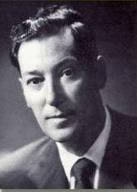
Neville Goddard (1905–1972) was a pioneering mystic, teacher, and lecturer in the realm of metaphysics, best known for his profound teachings on the power of imagination and the nature of reality. Born in Barbados, Neville moved to the United States as a young man, where he initially pursued a career in entertainment before embarking on a deep spiritual journey that would define his life’s work.
Over the course of several decades, Neville gave thousands of lectures and authored numerous books, all centered around the idea that consciousness creates reality. He drew heavily from biblical scripture, offering a radical interpretation that positioned the Bible as a psychological and mystical guide rather than a historical account. His teachings emphasize that imagination is the key to manifesting one’s desires, and that assuming the feeling of the wish fulfilled is the fundamental technique for changing one’s reality.
The Core of Neville’s Teaching
At the heart of Neville’s philosophy is the concept that “imagination creates reality.” He taught that what we hold in our minds—our assumptions, beliefs, and inner conversations—shapes the world we experience. His key principles include:
- The Law of Assumption – Reality conforms to our dominant assumptions. By believing and feeling as though our desires are already fulfilled, we draw them into existence.
- Revision – By mentally rewriting past events, we can change their influence on our present and future.
- Feeling is the Secret – Emotions and sensations are the bridge between thought and reality; experiencing the feeling of success or fulfillment internally brings it into the external world.
- Everyone is You Pushed Out – Our relationships and interactions mirror our inner states and assumptions.
Neville’s Legacy
It’s interesting to think that during his lifetime, Neville wasn’t a household name; he spoke in modest halls to those who were ready to listen. But his real legacy is the way his voice has only grown louder with time.
He didn’t build an empire or a religion; instead, he left behind a body of work that acts like a quiet, steady compass for anyone tired of ‘trying’ and ready to start ‘being’. To me, his legacy isn’t just in the books he wrote, but in the millions of lives, like mine, that have been quietly transformed by his radical trust in the human imagination.