
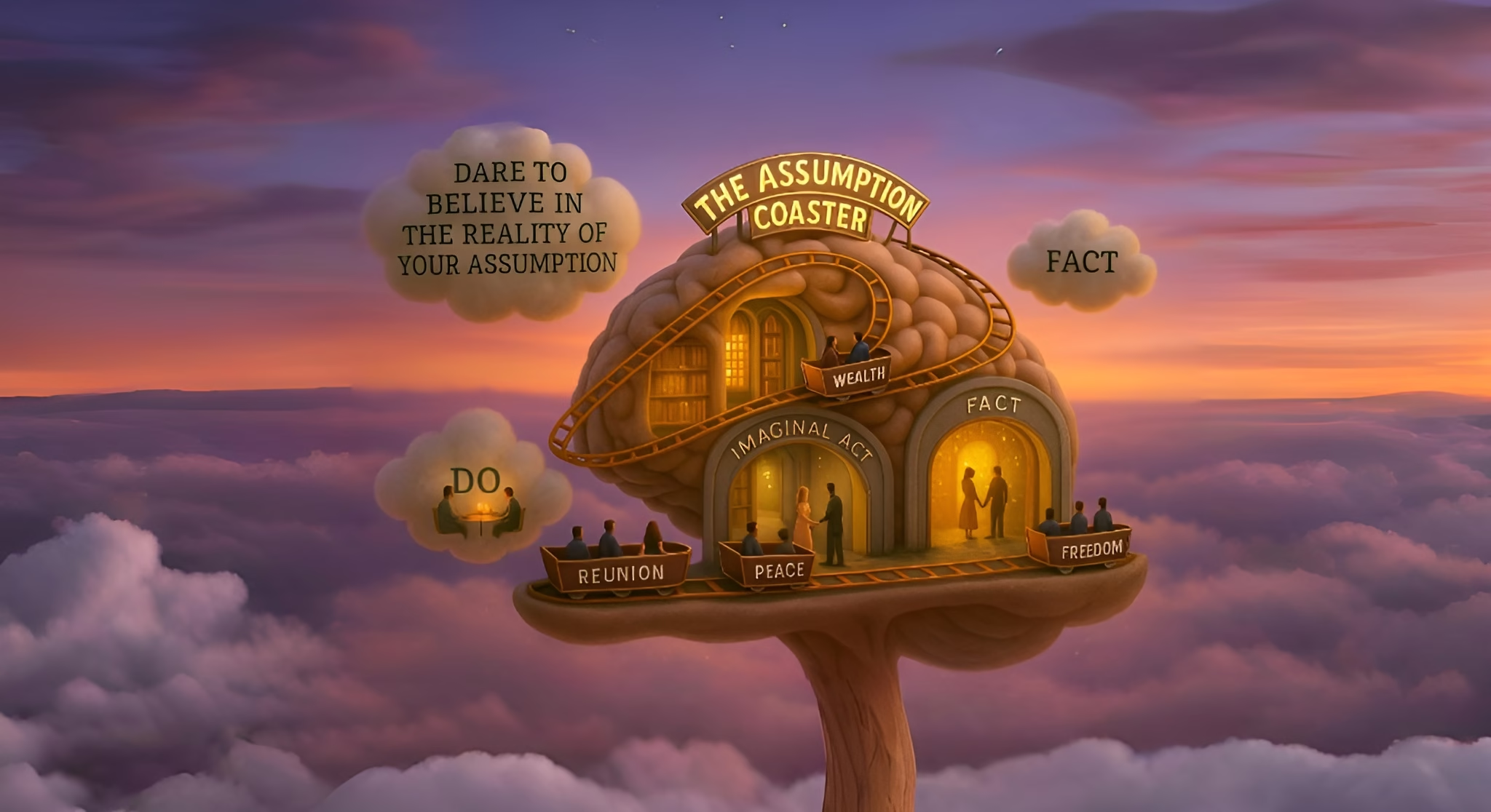
When I first came across Neville Goddard’s lecture Imaginal Acts Become Facts, something about it stayed with me. Not because it felt dramatic or extraordinary, but because it felt quietly familiar. It put words to something I had already sensed in my own life, that what we experience on the outside begins somewhere much earlier, somewhere unseen.
Neville’s message is simple, but it isn’t shallow. He teaches that imagination is not fantasy. It is the creative force of reality itself. And when we use it deliberately, when we return to the same inner experience again and again, what we imagine eventually becomes what we live.
This isn’t theory for me. It’s something I’ve watched unfold over time, often in small ways at first, and then in ways that were impossible to ignore.
What “Imaginal Acts Become Facts” Really Means
At the heart of Neville’s teaching is the idea that everything begins inwardly. Before something appears in your life, it exists as an inner experience, a thought, a feeling, an assumption about what is possible for you.
Neville describes life as a series of states. These states are not created or destroyed. They already exist as potential experiences. What changes is the one we occupy.
An imaginal act is simply the act of entering a state inwardly. It is imagining yourself already living the life you desire, and allowing that inner experience to feel natural and real. When that inner experience is returned to consistently, it stops feeling like imagination and starts feeling like identity. And when that happens, the outer world rearranges to match it.
That is what Neville meant when he said imaginal acts become facts.
The Power of States
Neville teaches that we move through life by moving through states of consciousness. Each state carries its own experiences.
Some common ones might be:
• The state of abundance
• The state of lack
• The state of love and connection
• The state of frustration or disappointment
The state you are in determines how life shows up for you. When I first understood this, it helped me stop blaming circumstances and start paying attention to what I was assuming internally. Not in a critical way, but in a curious one.
If imagination allows us to enter a new state, then imagination becomes the doorway to change.
How I Understand Using Imagination in Practice
Neville makes it clear that imagination is not something we switch on for a few minutes and then forget about. It is the core of who we are. Learning to use it consciously takes patience and gentleness.
This is how I approach it.
1. Becoming Clear About the State I Want
Instead of focusing on what I do not want, I ask myself what I would feel like if this were already resolved. Not what I would say or explain, but what I would quietly know.
Security. Ease. Confidence. Relief.
Those feelings point to the state.
2. Allowing the Feeling of Fulfilment
Living in the end, for me, is not about forcing emotion. It is about gently stepping into the feeling of already being there.
I might imagine a simple scene. Something ordinary. Something that implies the desire is fulfilled. And then I let myself rest in how that feels, without effort.
3. Returning to the Assumption
What Neville calls persistence feels less like strain and more like returning home. Each time doubt appears, I return inwardly to the same assumption, the same inner knowing.
Over time, the imagined state starts to feel more familiar than the old one.
4. Letting the Seed Grow
One of Neville’s strongest teachings is about not interfering after the imaginal act is done. I’ve learned that constantly checking, worrying, or questioning pulls me out of the state.
Once the feeling has been accepted inwardly, I try to let it be enough.
What I’ve Observed Over Time
Neville often shared stories of people whose lives changed after they applied his teachings. I’ve noticed the same pattern in my own experience.
Changes rarely arrive with drama. They arrive quietly.
Opportunities appear. Conversations shift. Decisions feel easier. What once felt impossible begins to feel obvious.
This is not because something is being forced into existence, but because the inner state has already changed.
Why This Teaching Matters
What I value most about Neville’s work is the responsibility it returns to us. Not as blame, but as empowerment.
• It shifts attention inward, where real change begins
• It builds quiet confidence through self-awareness
• It encourages consistency rather than effort
Seen through this lens, imaginal acts are not tricks or techniques. They are a way of relating to life more consciously.
If you want to explore this idea more deeply, it becomes much clearer when viewed as part of Neville’s wider method, which I’ve outlined in the complete guide on this site.
Common Misunderstandings
“Isn’t this just wishful thinking?”
Wishful thinking stays in the realm of hope. Neville’s teaching asks for something different. It asks you to experience inwardly what you want as if it is already real, and to return to that experience until it feels natural.
“It sounds too simple.”
It is simple. That does not mean it is easy. Simplicity requires consistency, and that is where most of the real work happens.
A Final Thought
This path isn’t about perfection.
It’s about patience, gentleness, and returning inward, again and again.
Imagination shows you what is possible. Faith allows it to unfold.
Together, they don’t just change circumstances, they change how you move through life.
And from there, everything else follows.


Q&A
Here a few common questions I’ve found on the online whilst looking for my own answers.
How do I use reason and logic with “Imagination + Faith”?
This is one of the questions I wrestled with quietly for a long time.
When I first came across Neville’s idea of faith, it sounded as though reason had to be switched off completely, as if faith meant pretending, denying, or overriding common sense. And that never sat comfortably with me.
What became clearer over time is that Neville wasn’t asking us to abandon reason. He was asking us to understand where reason belongs.
Reason governs the outer world, the world of facts, sequences, and evidence. Imagination, in Neville’s work, operates at a different level entirely. It isn’t trying to explain how something will happen. It’s concerned only with who you are being.
Neville often spoke about faith as assumption, not belief in something unseen, but acceptance of an inner state as true. In that sense, faith isn’t irrational. It’s pre-rational. It comes before logic has anything to measure.
What helped me was noticing this distinction:
- Reason asks: “How could this possibly happen?”
- Imagination asks: “What would it feel like if it were already true?”
Neville didn’t argue with reason, he simply didn’t give it creative authority.
In practice, this means you don’t have to fight your logical mind. You let it do its job in the world of action and decision-making. But when it comes to creation, you gently refuse to let logic decide what is possible.
I’ve found that faith becomes much easier when I stop trying to prove my imaginal acts to myself. Faith, as Neville described it, isn’t something you argue into place. It’s something that settles when the imaginal experience feels complete.
Over time, reason naturally follows.
Not because it’s been silenced, but because it’s no longer being asked to do a job it was never designed to do.
If this question resonates, it often helps to start small. Let imagination lead in quiet, ordinary moments. Let reason handle the rest of life. They don’t have to be enemies.
They just have different roles.
Do I need to ignore my senses and current reality to use Imagination + Faith?
No, and this is where Neville is often misunderstood.
You don’t have to deny what your senses are showing you or pretend that your current circumstances don’t exist. Neville never taught denial. He taught non-reaction.
The outer world is simply the result of past assumptions. It’s not something to fight or argue with, it’s something to outgrow.
Imagination works quietly, inwardly. Faith is choosing to return to the inner experience of your wish fulfilled, even while the outer world is still catching up.
You acknowledge what’s happening now, but you don’t let it decide who you are becoming.
That gentle shift, inward, not against reality, is where imagination and faith do their work.
Why does imagination sometimes feel easy and other times feel difficult?
I’ve noticed that imagination feels easiest when it matches the state I’m already in.
When an imaginal scene feels natural, it’s usually because it’s close to how I already see myself. There’s no strain, no effort, it simply flows. Neville would say the state is already familiar.
When imagination feels difficult, it’s often because it’s asking me to step into a state that feels unfamiliar or akward. The resistance isn’t failure, it’s information. It’s showing me where my assumptions still live.
Neville never said imagination should feel forced. If it does, it’s often a sign to soften the scene, simplify it, or return to feeling rather than imagery.
Ease comes with familiarity.
Difficulty fades as the state becomes known.
Want to Dive Deeper?
Download our free Practice Pack designed specifically for “Imagination Plus Faith”
This carefully crafted practice pack will help you harness the combined power of imagination and faith, transforming your understanding of these divine creative forces into tangible, life-changing results.
Download FREE Practice Pack

Leave a Comment